
FIFA
2K18
Soccer Balls
History
Now moving towards the ninth soccer ball sponsored by Adidas.
It was used in the 1970 world cup.
Its name was Adidas Telstar.

Telstar 1970
Adidas put their first stamp on the official World Cup ball at the 1970 World Cup in Mexico.
The German-based company designed high quality and well-liked balls for the 1968 European Cup and 1968 Summer Olympics in Mexico City and with the Mexican Football Federation advocating for them, FIFA decided to have adidas produce the ball.
The final product was the iconic adidas Telstar.
The black and white ball was constructed of 32-panels (12 black pentagons and 20 white hexagons).
The design was adopted to be easier to see on black and white televisions as the 1970 World Cup was the first with a global TV audience.
The name for the ball came from the Telstar communications satellite which has a similar appearance.
And the official World Cup logo emulated the design of the new ball.
20 Telstars were provided for the tournament matches while over 600,000 replica balls were sold.
The impact of the adidas Telstar changed the way fans embraced the official match ball while watching matches as well as playing on local soccer fields around the globe.
The tenth ball was supplied by Adidas in 1974.
Its name was Adidas Telstar Durlast.
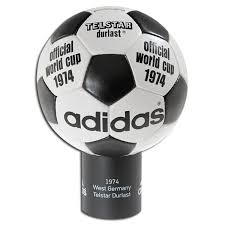
Adidas Telstar Durlast
Adidas sealed a deal as an Official Partner of the World Cup by the 1974 World Cup.
The deal made them the official ball provider for the tournament and allowed them to keep their name front and center on the ball.
After the success of the Telstar 4-years earlier only minor tweaks were required for the ball to get back out on the field.
A thicker coat of ‘durlast’ was applied to the new ball.
This helped it hold up better in wet weather as well as provided the shiny coat.
The Eleventh ball sponsored by adidas was in 1978.
Its name was Adidas Telstar Tango.

Adidas Telstar Tango
Adidas began the tradition of giving the World Cup ball a unique identity in 1978 when they developed a ball to celebrate the culture of the host nation.
The 1978 Word Cup ball was named after Argentina’s famous dance, the Tango.
The Tango featured the same number of panels as the Telstar but scrapped the black panels.
Instead, the ball had an all white base with black triads forming a circular pattern.
As the ball rolled, the effect of the pattern made it seem like the ball was performing a dance, making its name quite befitting.
While the Tango Ball became one of the most popular of all-time, the top brass back in Germany was not so confident heading into the World Cup.
They made sure to have some Telstar 1978 balls on hand in Argentina if the new ball was not well received.
They sponsored the Twelfth ball in 1982.
Its name was Adidas Espana.

Adidas Tango Espana
After a creating such a successful ball for ’78, adidas did not change much for the ’82 World Cup ball.
The Tango España was the first ball to be made out of leather and synthetic material.
A new polyurethane layer replaced the Duralast coating and the panel seems were welded then sewn together.
This ball was the final nail in the coffin of the leather ball and all the uncertainties it had provided over the first 52 years of the tournament.
The Tango España was the first ball to include the adidas Trefoil logo.
After a successful twelfth ball they sponsored their thirteenth ball.
Its name was Adidas Azteca in 1986.

Adidas Azteca
The Azteca was the first synthetic ball to be used at a World Cup.
The ball provided a truer spherical shape throughout matches, tested better for performance, and were water resistant.
Adidas took the triad pattern to the next level with the Azteca turning to Aztec architecture and mural designs for inspiration for the pattern.
This design element was continued for the next 3 World Cups.
The fourteenth ball was sponsored in 1990.
Its name was Adidas Etrusco Unico.

Adidas Etrusco Unico
The Etrusco Unico was the ball for the 1990 World Cup and celebrated the civilization and art of the Etruscans who thrived on the Italian peninsula between 768 BC and 264 BC. Each triad featured an Etruscan lion as well as stylized Etruscan border.
Very classical in its approach.
It was the first ball to have an internal layer of polyurethane foam.
The fifth teen ball was sponsored in 1994.
Its name was Adidas Questra.

Adidas Questra
The theme for the 1994 was space travel and the U.S.’ ‘quest for the stars,’ thus the Questra was born. The black and white ball featured a galactic scene on the triads.
The overall space theme was a tribute to the 25th anniversary of the Apollo 11 mission to the moon.
The Questra was a popular edition of the ball with color versions used at the UEFA Euro 1996 ‘Questra Europa,’ and the 1996 Olympics, ‘Questra Olympia.’
It closed out its service with the ‘Questra Apollo’ ball being used in La Liga and for the Spanish national team in 1996/97.
The ball was lighter and more responsive than earlier versions of the ball and well liked by the players.
The hope was that a more lively ball would increase scoring, which fell to a record low 4-years earlier in Italy.
It succeeded in being the highest scoring tournament seince 1982 but ironically 1 of the 3 games that ended 0-0 was in the final.
Adidas sponsored its sixteenth ball in 1998.
Its name was Adidas Tricolore.

Adidas Tricolore
The adidas Tricolore was a fitting closing for the Tango era.
The Tango’s triangle patter was shown in the colors of the French flag, red, blue, and white.
It was the first multi-color ball used at the World Cup finals.
In addition to the color of the ball, It had a circle pattern on the ball that gave it a more modern look than previous Tango editions.
The new colors was only the tip of the iceberg for new looks to come from adidas.
The seventeenth ball was sponsored in 2002.
Its name was Adidas Fevernova.

Adidas Fevernova
The Fevernova 2002 World Cup match ball was the start of a new era for World Cup match balls and with that came high expectations.
The Fevernova marked the end of the Tango era that started 24 years earlier at the 1978 World Cup.
The most notable feature of the ball was the foam synthetic layer under the outer coating.
The material gave the ball a spongy feel which immediately made players wary despite adidas assurances that it helped improve the durability and true response from being kicked.
The gold (champagne) ball featured a shuriken, ninja throwing star, design with red flames representing the achievements of the first Asian hosts of the World Cup.
The eighteenth ball was sponsored in 2006.
Its name was Adidas +Teamgeist

Adidas +Teamgeist
The Germans pride themselves in working as a unit rather than relying on individual performances. The name +Teamgeist, team spirit, is a clear reference to that tradition.
The out-of-place ‘+’ at the start of the ball name was added for trademark reasons but gave a distinctive if not unusual stamp on the ball.
The 14-panel ball was the first to be held together with thermal bonding rather than being stitched.
The ball had other first including being the first to be available with the competing teams, venue, and date stamped on the ball. It also featured a special colorway for the World Cup final, the +Teamgeist Berlin.
The nineteenth ball was sponsored in 2010.
Its name was Adidas Jabulani.

Adidas Jabulani
The Jabulani is arguably the most hated World Cup soccer ball in the history of the tournament. Especially if you asked a goalkeeper.
Spain’s goalkeeper at the time summed it up best saying, ‘(It is) like a beach ball.’
He was not alone, France’s Hugo Loris, Italy’s Gianluigi Buffon, and David James of England all used 1 word to tell the story, ‘Disaster,’ ‘Shameful,’ and ‘Dreadful,’ respectively.
Field players were not completely sold on the ball either.
They loved the knuckling factor when it helped them score past a bewildered often flat-footed goalkeeper but Clint Dempsey spoke about the downside, ‘If you (pass/strike) it just a little bit wrong, you end up looking pretty silly.”
The 8-panel ball was adidas attempt at ball that was a perfect sphere with the latest technological advances to improve the flight of the ball with fewer seams.
The reality was a ball that was lightweight and prone to knuckle unexpectedly.
A far cry from adidas hope to ‘celebrate,’ the meaning of Jabulani in Zulu.
It had a good look, however, with 11 colors on the ball representing the 11 players on each team on the field, the diversity of the 11 official languages spoken in South Africa, and it being the 11th official World Cup ball provided by adidas.
The twentieth ball was sponsored in 2014.
This ball was vey widely used all over the world.
Its name was Adidas Brazuca.

Adidas Brazuca
The 2014 World Cup ball, the Brazuca, was the first match ball to create a buzz before it even made it to the field with its own social media following and storytelling voice.
The Brazuca was 100% Brazilian which makes sense as Brazuca is a slang term for Brazilian.
The 6-panel ball was the most colorful in the history of the game with flowing wish bands in green, blue and orange on the ball.
The ball became a staple and was used in professional leagues around the world like the German Bundesliga and Major League Soccer in the U.S. and Canada.
And more than anything it was a welcome change from the Jabulani from 4 years earlier.
The twenty one ball is also sponsored by adidas.
This ball name is a copy of 1970 ball.
Its name is also Adidas Telstar.

Adidas Telstar
The Telstar 18, the official ball of World Cup in Russia, has a familiar look.
The black and white ball is a modern interpretation of the famous 1970 Telstar.
The Telstar was the first to be provided by adidas and the 3-stripes has been the official match ball provider since that tournament.
The 6-panel ball incorporated the latest ball technology and has been through extensive testing but the pixilated gives the impression of the old 32-panel original Telstar.
This is the first World Cup match ball to be predominantly black and white since the Questra was used at the 1994 World Cup in the USA.
FIFA 2018 Official Song:


